Tuesday, 5 July 2016

Why Failure Is the Key to Success for Women

When I bodysurfed with my three brothers as a kid, I didn’t hate wiping out as much as I hated my brothers’ laughing at me when I emerged from the wash of a big wave spluttering and gasping for air, swimsuit askew. I had a choice, I could either stop bodysurfing (and thus get left behind) or get used to getting dumped. Eventually I figured out a solution: wipe yourself out so you get used to it and don’t dread it as much.

What I discovered after a few self-imposed poundings was that if you can find the sand, you can find the air; it’s in the exact opposite direction. And the wave is always happy to introduce you to the sand. Usually it was right where my face was planted. So, if you let the surf fling you about a bit, you can eventually get the sand under your feet and emerge from the water with your swimsuit and composure more or less intact. I still got dumped, but I did it with a little more dignity.
What I now realize I was learning to do, was fail.
Women need to fail. They need to fail hard and they need to fail often. It’s the only way they’re going to succeed. It seems cruel to say that. For many women, lack of success is as familiar as breakfast cereal, except they eat it three meals a day. But a new poll conducted for Time and Real Simple magazines suggests that an unwillingness to fail or a fear of doing anything that could lead to a washout might be one of the pinch-points that is impeding women’s progress to the head office. Failures happen to everyone, but these poll results suggest that women fear them more and perhaps don’t bounce out of the surf from them quite so readily.
As part of an ongoing national conversation about why women occupy leadership roles in much smaller numbers than their education, their ability and just simple math would suggest, the polling company Penn Shoen Berland asked 1000 women about success, what it meant to them and what they felt it took to be successful. They also asked 300 men some of the questions to offer a point of comparison. The women ranged in age from 20 to 69 and about 40% of them were in paid employment.
Some of the poll data confirmed what our gut tells us: for women success is less like a spearfishing trip and more like collecting shells on the beach. It’s not a linear process, with just one goal in mind. Secondly, motherhood has a huge influence on women’s outlook, both in her definition of success (it widens) and in her bandwidth (it bifurcates). Other results were more surprising: being good at their jobs was vastly more important to women than men in our survey. And almost half of them believe they are paid less than men for doing an equivalent job.
The biggest bogeyman in the discussions about what’s holding women back is a lack of confidence. Why do women not ask for higher salaries when negotiating? Confidence. Why are women the last to put up their hands for a promotion? Confidence. Why don’t more women run for office? Confidence. Plus all the guff they’d have to take about their hair.
That idea may need refining. One of the clearest finding to emerge from the Time/Real Simple poll is that women aren’t much less confident than men. About 45% of people regardless of gender regard themselves as confident. But many more women—nearly 80%—say it’s an important part of success. Only 63% of men do. That is, women and men are confident in equal measure. But more women think it’s important.
Female workers, the poll numbers show, labor just as hard, believe they are just as qualified, and have as much professional respect as their peers. That sounds a lot like confidence. Yet they just don’t seem to swim for the waves the men do. Roughly three quarters of both men and women said they would not want their boss’s job. But, if offered the position, more than half the men would take it anyway and fewer than a third of the women would. Why do the men believe they could do the job and the women don’t?
The demands of motherhood may be one of the forces at play here, but it’s not the only one. According to the poll, women’s hunger for success dwindles as they age. Almost 75% of women in their 20s regard it as very important to be successful. By their 40s and 50s—the age at which people often become senior executives—only 50% of the women feel the same way. About half the 20 year old women surveyed considered it vital to get promoted. Less than a third of women in their 40s felt the same way.
If this were all just because women wanted time and energy and bandwidth for that resource-intensive home-based start-up called parenting, then it follows that their desire to contribute to the success of their team or to work as hard would ebb too. But it doesn’t wane at all, no matter the age. Women seem to want to put in the time and effort, but not to expect the rewards. Or the status.
Perhaps there’s an answer in women’s attitude to innovation. More than 40% of women believe the ability to innovate is one of the passports to success. But only a few women think they carry that passport. What do confidence and innovation have in common? They can’t be learned without making mistakes. Acquiring them without going through failure is not an option. Failure often hurts, but as Lawrence of Arabia said (in the movie, at least) “the trick is not minding that it hurts” and swimming back through the swell to try again. Women seem less eager to do this. What is innovation, after all, but failing to solve a problem a little less badly each time?
One nugget from the poll encapsulates this quite neatly: to prepare for a big presentation women are more likely than men to do a lot of research and give themselves a pep talk. Men, on the other hand, were more likely than women to give themselves a treat, take meds or practice their power pose in the bathroom. The men are much more likely to revel in the high wire act, to enjoy the risk, than women. (Either that or their meds are amazing.)
It makes sense that women are risk averse. That tendency has protected them and their offspring for centuries. It fortified those pioneering female business leaders who were under a higher level of scrutiny even as recently as this decade. But if women hope to get to the corner office, to that mythical realm that smells like Y chromosomes and golf shoes, they have to be prepared to fall on their faces. And get back on up again.
So here’s a suggestion. Go forth, ladies and louse up. Muff it. Make a blunder. Botch it up royally. Make a complete balls of it. The guys do it all the time. Just before they get promoted.

Tuesday, 21 June 2016


SMGEO INAKUJA NA KAMPENI MPYA , IITWAYO "SEMA MTANZANIA,KUWASAIDIA WATANZANIA" ambayo inakupa nafasi yako wewe Mtanzania kutumia haki yako ya kikatiba kutoa maoni bila kuvunja sheria kwa kusaidia serikali yako na wananchi wenzako.
Tumia fursa hii adimu kusema maoni yako kwa chochote ili Tanzania na wananchi wake wasonge mbele kimaendeleo.
Chakufanya Download hiyo picha  halafu andia caption au ujumbe wako kwa serikali au watanzania mwisho hitimisha kwa maneno  SEMA MTANZANIA, KUWASAIDIA WATANZANIA

SEMA KWA WATANZANIA, WASAIDIE WATANZANIA.
TANZANIA NI YETU , MAONI NI MSINGI WETU

Mkurugenzi Mtendaji
Social Mainstreaming for Gender Equality Organization
P.O.BOX 6444
MOROGORO TANZANIA
+255 753599 827
smgeo2015@gmail.com

Friday, 17 June 2016

Don’t be gender blind. Take a moment to understand gender gaps in education.

It may surprise many that, in global terms, girls make up just 52% of out of primary school age children. At the secondary level there are actually fewer girls out of school than boys. When averaging out the gender parity index across all countries, you will find that gender parity has actually been achieved globally in both primary and secondary education.

Given the loud cries for girls to be prioritized in education policies these facts don’t add up. Why?
For a start, many countries with large populations – in particular, India, Brazil and China – have achieved gender parity in primary education and constitute a large slice of the global pie. Global figures cover up the entrenched disparities faced by girls in many countries in sub-Saharan Africa, and in parts of South and West Asia and the Arab States, where populations are relatively smaller. At the secondary level, many countries in Latin America and the Caribbean have disparities at the expense of boys, not girls. This, together with more conventional disadvantages faced by girls in other regions, creates a seemingly balanced global portrait.
673505X9WPX8TU
It is a rare occasion where a global figure puts a positive gloss on a story, as is the case with gender. But the fact remains that global gender figures obscure large gender gaps in many different countries. For example, they don’t show that there are five times more countries with extreme gender disparities at the expense of girls than of boys in primary school. Nor do they show that almost half of out-of-school girls of primary school age will never set foot in a classroom, equivalent to 15 million girls, compared with just over a third of the boys. The proportions in sub-Saharan Africa are even worse.
6735RALUUPUL1L
It is precisely because of how extreme gender gaps are at the expense of girls, and how entrenched their disadvantage is that any projections for primary or secondary completion rates are so revealing. The GMR 2013/4 showed, for instance, that the poorest girls in sub-Saharan Africa would achieve lower secondary completion more than 20 years later than the poorest boys.
There is, therefore, solid reasoning behind advocates calling for girls to be prioritized. It requires an understanding of the impact that different contexts can have on gender gaps, and explains why it is that the poorest girls are the furthest behind of all. It is wrapped up in the knowledge that, in addition, girls’ education has even stronger positive effects on development outcomes.
To help visualize the complexities of this story, the EFA GMR has developed an online interactive tool to show the extent to which specific contexts influence the size of the #gender gap in different countries and regions.
It shows, for instance, that in sub-Saharan Africa, the poorest girls are almost nine times more likely never to have set foot in a classroom than the richest boys.
Click to view in dataviz
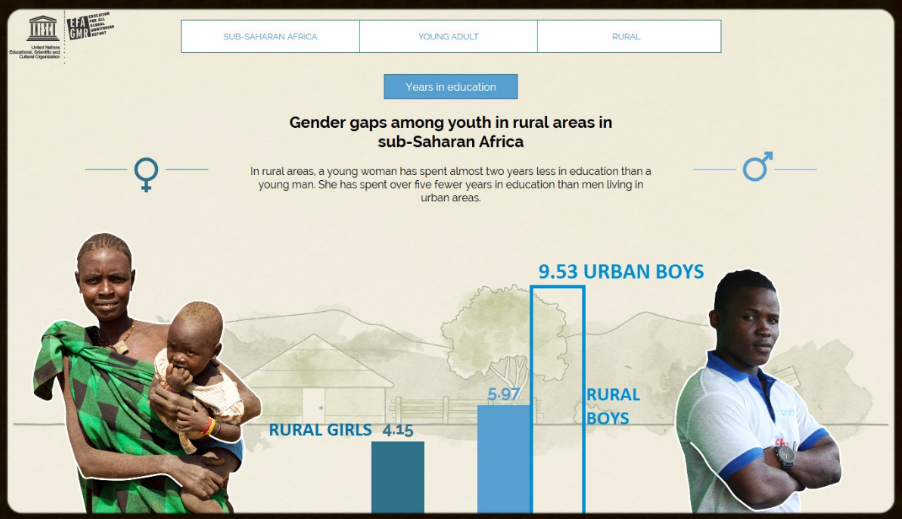
Rural young women in sub-Saharan Africa have on average spent at least five years fewer in education than men living in urban areas.
Click to view in dataviz
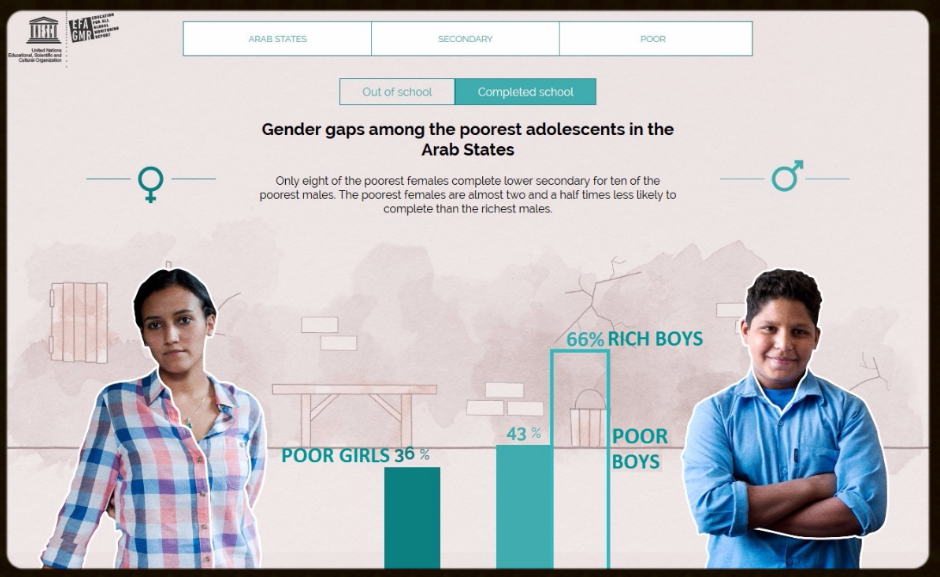
In the Arab States, the poorest females are almost two and a half times less likely to complete lower secondary education than the richest men.
Click to view in dataviz
In Latin America and the Caribbean, however, the graphic shows clearly that boys are at a disadvantage: 55% of boys compared to 63% of girls in rural areas complete lower secondary education.
Click to view in dataviz
The figures used in this tool are taken from the EFA GMR’s Worldwide Inequalities Database on Education (WIDE). It is a crucial instrument for understanding the real impact of disadvantages such as gender, wealth, language and location on unequal education outcomes in countries around the world. It shows that what may seem one story on the surface is another story in reality. It illustrates how an equity perspective can help us to better analyse progress towards the new post-2015 education agenda.

Wednesday, 15 June 2016

The founders of SMGEO speaks about Gender Equality !!


Gender equality is more than a goal in itself. It is a precondition for meeting the challenge of reducing poverty, promoting sustainable development and building good governance.

From the right The SMGEO executive secretary Mr Bonifasi Mhanga and Managing Director of SMGEO Mr Eric Samuel continues with their daily activities at Dar es Salaam., Tanzania.

Inequality between women and men has been clearly identified as one of the causes blocking development over the last two decades.
It is often difficult to establish evidence based causal links between impacts of gender inequality on a country’s development because of the lack of available sex-disaggregated data.
And because of limited data, we also can’t capture the complexity of gender inequality in different contexts (such as looking at the gender specific effects of public investment cuts for example).
One way to measure gender inequality is to look at the differences for women and men in areas such as education, healthdecision making and access to economic opportunities.
Analysis based on quantitative data reveals that considerable progress has been made in terms of women’s access to education and healthcare in different regions. 
However, this level of analysis doesn’t show how gender inequality influences policies. This is why we decided to dig deeper.
For instance, increasingly, many governments in this region decided to invest in education, in part to encourage participation in the labour market – which would then boost economic development.
However, most investments supported by education policies are gender blind: data from all countries in the region reveal that investments in education produce distinct outcomes for women and men:
  • Women outnumber men in universities
  • Working women have higher university degrees than men
But investments in education are not directly leading to women participating in the labour market. On average, in the region, women represent 44 percent of the workforce.
So, why is it that the gains in women’s education don’t increase the number of women in the workforce? And how can we change it?
The reason why investments and education policies are producing different outcomes for women and men is because they happen in societies where gender inequality is deeply entrenched.
Gender inequality is often driven by existing gender stereotypes that determine how we perceive the roles of women and men in society.
Investment in education can actually reinforce existing patterns of gender inequality.
In university, women are typically over-represented in subjects such as health, social science and education, and consequently, these choices influence their job choices, and in the long run, their competitiveness in the labour market.
Women also tend to be over represented in public employment (health, education), and consequently, they are less likely than men to be re-employed in similar jobs in the private sector, putting them at a disadvantage if they lose their job – not to mention increasing state investment in social benefits.
In a time of the financial constraints, this situation represents a waste of resources and consequently, impedes development progress.
Even though the loss cannot be estimated in actual cash terms and detailed impact cannot be established for each country because of limited data available in the region, we wanted to give it a try.
Our organization has started to establish campaign and project on gender issues  and development in Tanzania Mainland.

join to us,
SMGEO founders
smgeo2015@gmail.com

7 of the biggest achievements of women in science !!


7 of the biggest achievements of women in science
Women and science: It’s complicated (Picture: Culture Club/Getty Images)
Women and science haven’t always had the easiest relationship.
Even today as people, women only make up 14.4 per cent of people in STEM careers according to the latest statistics from the Women in Science and Engineering campaign.
But still, for centuries there have been women who were determined and did prove all the doubters wrong.
Here are some of the biggest achievements in science done by women.

1) Discovered two elements and died from the cause – Marie Curie

A portrait of Marie Curie, who along with her husband, discovered radium. Paris, France: December 26, 1923n(Photo by Underwood Archives/Getty Images)
Marie Curie (Picture: Underwood Archives/Getty Images)
She quite literally lived and died for her work. Marie Curie discovered two radioactive elements – polonium and radium – and won two Nobel prizes before succumbing to radioactivity exposure in 1934.
To this day her notebooks are too radioactive to handle without specialist equipment. The Marie Curie charity that provides care and support to people with terminal illnesses and their families is named after her.

2) First female qualified doctor – Elizabeth Anderson

'Lady Physicians', 1865. Who is this interesting invalid? It is young Reginald de Bracks, who has succeeded in catching a bad cold, in order that he might send for that rising practitioner, Dr Arabella Bolus!. In 1865 Elizabeth Garrett Anderson (1836-1917) was licensed to practice by the Society of Apothecaries. Having been refused admission to medical schools (on grounds of her sex) in 1860, she began to study privately and was granted her MD in Paris in 1870. Cartoon from Punch, London, December 1865. (Photo by Oxford Science Archive/Print Collector/Getty Images)
Cartoon from Punch in 1865 examining attitudes towards female doctors (Picture: Oxford Science Archive/Print Collector/Getty Images)
Elizabeth was inspired to become a doctor after meeting the first female doctor in the U.S, Elizabeth Blackwell, giving her a resolute determination to become a doctor herself, despite all obstacles.
When no medical school would allow her to study alongside male doctors, she attempted a number of strategies to become qualified. As a nursing student at Middlesex Hospital she would sneak into medical lectures, and even got herself banned from classes with male colleagues after complaints.
Even after she got a medical degree in Paris, she wasn’t allowed on the British Medical Register until an act legalising women entering the profession was passed.
A lesson in never giving up.

3) Worked on the first atom bomb – Chien-Shiung Wu

Physicist Dr. Chien-Shiung Wu standing amidst tubes of a particle accelerator at Columbia University. (Photo by Robert W. Kelley/The LIFE Picture Collection/Getty Images)
Physicist Dr. Chien-Shiung Wu standing amidst tubes of a particle accelerator at Columbia University. (Picture: Robert W. Kelley/The LIFE Picture Collection/Getty Images)
Often referred to as the First Lady of Physics, Chien-Shiung has become known for her work on the Manhattan project that led to the first and so far only use of nuclear weapons in warfare.
She caught the attention of the U.S. government for her work in nuclear fission and was invited to work on the project at Columbia University. She helped to develop a process that enabled large extractions of uranium to be used as the bomb’s fuel.
After WWII, she remained at Colombia until her retirement.

4) Developed the drug that first gave hope to people with HIV and AIDS – Gertrude B Elion

Gertrude Belle Elion (January 23, 1918 - February 21, 1999)[1] was an American biochemist and pharmacologist, who shared the 1988 Nobel Prize in Physiology or Medicine with George H. Hitchings and Sir James Black. Working alone as well as with Hitchings and Black, Elion developed a multitude of new drugs, using innovative research methods that would later lead to the development of the AIDS drug AZT Source: Wikipedia LINK: https://en.wikipedia.org/wiki/Gertrude_B._Elion
Gertrude Elion gave many hope (Picture: Wikipedia)
The treatment of HIV has come a long way since the 1980s epidemic, and that’s partly down to this woman.
After her retirement in 1983, she oversaw the adaption of azidothymide, which would become the first drug to be used to treat AIDS.
In particular, it reduced the replication of the virus in a person’s system and prevented transmission between mother and child during birth.

5) Discovered comets and was the UK’s first female recognised scientist – Caroline Hershe

UNITED KINGDOM - JUNE 27: Engraving showing the astronomer Caroline Herschel (1750-1848) in 1841 at the age of 92. Caroline was the younger sister of the famous astronomer Sir William Herschel (1738-1822). She was a devoted observing assistant to William during his life, but was also an accomplished observer in her own right. Her first accomplishment was the discovery of three new nebulae in 1783, one of them being the companion of the Andromeda nebula. Between 1786 and 1797 Caroline discovered no less than eight new comets. She was awarded a gold medal by the Prussian Academy of Science on her 96th birthday. She was also jointly the first woman to be made a member of the Royal Astronomical Society. (Photo by SSPL/Getty Images)
Engraving showing the astronomer Caroline Herschel (Picture: SSPL/Getty Images)
The German British astronomer’s most significant contributions to science were a number of comets, including the periodic comet 35P/Herschel–Rigollet, though she is remembered also for being the first woman to be recognised and paid for her achievements, being awarded the Gold Medal of the Royal Astronomical Society.
Oh, and she lived until she was 97. What a badass.

6) First person to be accepted in chimpanzee society – Jane Goodall

British researcher, environmental activist and UN peace ambassador Jane Goodall gestures during a ceremony awarding her the XXIV International Prize of Catalonia award at the Generalitat Palace in Barcelona on July 27, 2015. The "Premi Internacional Catalunya" gives recognition to the work of individuals who have contributed to the development of cultural, scientific and human values around the world. The winner receives a prize fund of 80,000 euros (104.600 USD) and a piece of art. AFP PHOTO / LLUIS GENE (Photo credit should read LLUIS GENE/AFP/Getty Images)
She knew how to make friends among the primates (Picture: LLUIS GENE/AFP/Getty Images)
Her groundbreaking research and unusual methods have brought her criticism and praise alike.
During her 55-year-study of chimpanzees and their behaviour in social and family situations, contemporaries expressed concern over her method of naming the animals she was examining instead of numbering them.
She observed human behaviours among chimpanzees, including hugs, kisses and pats on the back.

7) Paved the way for IVF treatment – Anne McClaren

Anne Laura Dorinthea McLaren Source: Wikipedia LINK:https://en.wikipedia.org/wiki/Anne_McLaren
Millions of families have this woman to thank for their ability to have children (Source: Wikipedia)
Parents everywhere who needed medical help to conceive their much-wanted children have this woman to thank.
Her work as a leading figure in developmental biology, such as mouse embryonic transfer, helped to develop the techniques used in human IVF.
A firm believer in family time, as a professor she always ticked off married students working late in the laboratory, insisting they should be at home during the evenings.


Read more: http://metro.co.uk/2015/10/14/7-of-the-biggest-achievements-of-women-in-science-5437256/#ixzz4BdvvcN7L

12 Things Successful Women Do Differently


GETTY
Every woman has her own definition of success. But there are certain traits that most successful women share.
I spend a good part of my work day reading and writing about women who have achieved great things — and I make it a point to surround myself with women who are well on their way to doing so.
Here are 12 things I’ve learned that successful women do differently:
1. They are deeply passionate about what they do.
“Without passion, all the skill in the world won’t lift you above craft,” wrote dancer Twyla Tharp in her book, The Creative Habit. If you don’t love what you do, you’re probably not going to be motivated to go above and beyond, to innovate and to stand out in the workplace. But if you’re passionate about your career, it will make putting time and effort into it pleasurable, not a chore.
2. They don’t expect perfection — of themselves or those around them.
Research has shown that wasting time and energy trying to be “perfect” only leads to unhappiness. Successful women know that that they can’t do everything well all the time. Beating yourself up for your perceived flaws will only dampen your abilities at work, not to mention your mental health. “We each, if we’re lucky, will have our chance to leave a mark on the world, but we are trying too hard to be perfect,”wrote Barnard president Debora Spar in an op-ed for Glamour magazine. “So don’t emulate Wonder Woman; think about what’s wonderful to you instead. Then boldly, audaciously, joyfully, leave the rest behind.”
3. Often, they become the boss. 
Many successful women have figured out that if you’re the boss, you can set your own rules. As editor-in-chief of Cosmopolitan Joanna Coles said at the Third Metric Conference in June: “The higher you go in a corporation, the easier it is ... The truth is you get more control.” And when you’re in control, you have the ability to create a more sane, happy and balanced workplace for yourself and your employees.
4. They marry well — or not at all.
Successful women know the value of a true partnership. As Sheryl Sandberg observed in Lean In: “I don’t know of a single woman in a leadership position whose life partner is not fully — and I mean fully — supportive of her career.” And many successful women forgo marriage all together. Despite not being wed, women like Oprah Winfrey, Condoleezza Rice and Diane Keaton seem to be doing just fine.
5. They believe that they will be successful.
Not to go all “If you build it, he will come,” on you, but believing in your own success — no matter how crazy your idea might seem — is integral to achieving it. Kay Koplovitz, founder of the USA Network, echoed this sentiment in a July interview. “You have to be comfortable that you can think your way through and actually execute your way through to the desired outcome,” she said. “I expected to be successful.” Bottom line? Confidence — and faith in yourself — is key.
6. They’re not afraid to take risks.
Sheryl Sandberg says that all women should ask themselves the question: “What would you do if you weren’t afraid?” Affecting change — in your career and beyond — requires the ability to stop playing it safe every once in awhile. Successful women don’t make reckless decisions, but they do know how to take a calculated risk. Sandberg took her own advice, and wrote the bestseller, Lean In.
7. They know that failure goes hand-in-hand with success. 
Failure is not the opposite of success but a stepping stone to success,” was the advice given to Arianna Huffington by her mother, Elli Stassinopoulos. Successful women know that you can’t excel all the time, and that an inevitable part of taking leaps in your career is falling down sometimes. For example, 12 publishers rejected J.K. Rowling’s first Harry Potter book. But that didn’t stop her from continuing to send it out.
8. They take care of themselves physically.
“My morning run is when my head is most clear and when I synthesize all of the things that are going on in my head,” Jessica Herrin, founder of Stella and Dot, told The Huffington Post. Many successful women have spoken about the value of regular exercise — not because they are trying to be thin, but because they know that exercise relieves stress, releases endorphins and increases energy. “If I didn’t run, swim, or lift weights, I almost certainly would have killed someone by this point in my life,” wrote Debora Spar.
9. They know that their to-do lists will never be completed, and they’re okay with that.
Sometimes you can be more productive by accepting that you’re simply not going to get everything done. Learning to let go of certain goals, responsibilities and tasks can be difficult, but freeing. Arianna Huffington has spoken about how finally allowing herself to cross unrealistic goals off her lifelong “to do” list — in her case, learning German and becoming an expert skiier — relieved her of a huge burden. “Getting rid of the anxiety of perpetually unmet expectations was so great,” she said.
10. They make sure to schedule alone time.
Research has shown that women tend to prioritize domestic responsibilities such as housework and child care over themselves. Successful women know that they need to schedule alone time the same way they plan meetings, family dinners and networking events. “I’ve found if I don’t literally put pen to paper (or create a Google calendar appointment) and carve out an hour for myself, it never happens,” Mary Kate McGrath, editor in chief of PureWow told The Daily Muse in March. “So that’s what I do. I literally invite myself to manicures or an extra 20 minutes in bed, and I’ve been known to take myself out for a Manhattan once in a while, too. (I’m a great date.) And my new rule: I’m not allowed to cancel on myself.”
11. They know how to foster genuine relationships — and keep them strong.
Having a support network is key to being successful. Keeping up your friendships and forming new ones at every place you work makes you happier and helps your career later on. In 2009, Diablo Cody told the New York Times about the importance of her relationships with fellow female filmmakers Lorene Scafaria, Dana Fox and Liz Meriwether. “They helped me be excited for things when I was kind of shellshocked,” she said. “They were the ones who had to literally take me aside at the ‘Juno’ premiere and say: ‘This is fun. You will never forget this. Please enjoy yourself.’”
12. They express gratitude to those around them.
No woman’s success happens in a vacuum. Wildly successful women acknowledge those that support them every day — both in their home lives and at the office. And that graciousness not only makes them better people, but fosters loyalty from their employees. Oprah is one powerful woman who understands the value of appreciating her employees. In 2009, she took her entire staff and their families on a Mediterranean cruise.

marriage is not only wedding is just on how you handle relationship after marriage

we need to be full in love and real in action about  our heart to avoid divorce and break up in relationship.
love means prove how you care  unconditionally.