What are the poorest countries in the world? The rankings below were
published in Wikipedia from International Monetary Fund’s 2011 gross
domestic product per capita (GDP per capita) report and reflecting the
countries with the lowest purchasing power parity (PPP). Since 1970,
there has been encouraging news emerging from developing countries.
According to the UN’s 2010 Human Development Report, life expectancy in
developing countries has increased from 59 years in 1970 to 70 years in
2010. School enrolment climbed from 55% to 70% of all primary and
secondary school-age children. Also, in the last forty years, per capita
GDP doubled to more than ten thousand U.S. dollars. Poor countries are
catching up with the wealthier countries, but not all countries are
making fast progress. For example, some countries in Sub-Sahara Africa
have little or no progress, largely due to the HIV epidemic and civil
wars.
The 20 Poorest Countries:
#1. Democratic Republic of the Congo
GDP Per Capita: $348 (As of 2011)
Not to be mixed with the neighbouring Republic of Congo, the
Democratic Republic of the Congo has become the poorest country in the
world as of 2010. Democratic Republic of the Congo was known as Zaire
until 1997. Congo is the largest country in the world that has French as
an official language – the population of D.R Congo is about six million
larger than the population of France (71 million people in D.R Congo vs
65 million in France). The Second Congo War beginning in 1998 has
devastated the country. The war that involves at least 7 foreign armies
is the deadliest conflict in the world since World War II – by 2008 the
Second Congo War and its aftermath had killed 5.4 million people.
#2. Liberia
GDP Per Capita: $456 (As of 2011)
Liberia is one of the few countries in Africa that have not been
colonized by Europe. Instead, Liberia was founded and colonized by freed
slaves from America. These slaves made up the elite of the country and
they established a government that closely resembled that of the United
States of America. In 1980 the president of Liberia was overthrown and a
period of instability and civil war followed. After the killings of
hundreds of thousands, a 2003 peace deal was led to democratic elections
in 2005. Today, Liberia is recovering from the lingering effects of the
civil war and related economic dislocation, with about 85% of the
population lives below $1 a day.
#3. Zimbabwe
GDP Per Capita: $487 (As of 2011)
The government of Zimbabwe released its largest bank note 100
trillion dollar bill issued on January 2009. In addition to the economic
problems the life expectancy of Zimbabwe is the lowest in the world –
37 years for men and just 34 for women. One of the problems for the
early deaths are the 20.1% of the population with HIV and AIDS. The
health issues aren’t seeing any improvement.
#4. Burundi
GDP Per Capita: $615 (As of 2011)
Burundi is known for its tribal and civil wars. Burundi have never
really had any peaceful time between the everlasting civil wars as a
result its the fourth poorest country. Owing in part to its landlocked
geography, poor legal system, lack of economic freedom, lack of access
to education, and the proliferation of HIV and AIDS. Approximately 80%
of Burundians live in poverty and according to the World Food Programme
57% of children under 5 years suffer from chronic malnutrition; 93% of
Burundi’s exports revenues come from selling coffee.
#5. Eritrea
GDP Per Capita: $735 (As of 2011)
Affected by the Italian colonizers of the 19th century. Eritrea’s
advantage of controlling the sea route through the Suez Canal made the
italians to colonized it just a year after the opening of the canal in
1869 and same reason the British conquered it in 1941. The present
Eritrea’s economic conditions have not improved and real gross domestic
product growth averaged 1.2 percent between 2005 and 2008; in 2009 GDP
growth was estimated at 2.0 percent.
#6. Central African Republic
GDP Per Capita: $768 (As of 2011)
Despite its significant mineral resources; uranium reserves in
Bakouma, crude oil, gold, diamonds, lumber, hydropower and its arable
land, it remains one of the poorest countries in the world. Diamonds
constitute the most important export of the Central Africans Republic,
accounting for 40–55% of export revenues. The 2010 UNDP Human
Development Report ranks CAR near the bottom of its Human Development
Index (159th out of 162 countries) and unlikely to meet its MDG goals.
The proportion of Central Africans living on $1 a day has decreased
slightly to 62% but it needs to be half of that in order to reach the
2015 goal.
#7. Niger
GDP Per Capita: $771 (As of 2011)
With over 80% of its land is covered by the giant desert of Sahara,
Niger has a Gross Domestic Product (GDP) per capita in Parity Purchasing
Power (PPP) terms of US$771 as of 2011, one of the lowest in Africa.
Niger’s poverty is exacerbated by political instability, extreme
vulnerability to exogenous shocks and inequality which affects girls,
women and children disproportionately
. In
January 2000, Niger’s newly elected government inherited serious
financial and economic problems including a virtually empty treasury and
was qualified for enhanced debt relief under the International Monetary
Fund program for Highly Indebted Poor Countries.
#8. Sierra Leone
GDP Per Capita: $849 (As of 2011)
A West African country with English as its official language, Sierra
Leone has relied on mining, especially diamonds, for its economic base
and home to the third largest natural harbour in the world where
shipping from all over the globe berth at Freetown’s famous Queen
Elizabeth II Quay. It is among the top diamond producing nations in the
world, and mineral exports remain the main foreign currency earner
and also among the largest producers of titanium and bauxite, and a
major producer of gold. Despite this natural wealth, 70% of its people
live in poverty. If you have seen the movie Blood Diamond you should
know that it is based on Sierra Leone.
#9. Malawi
GDP Per Capita: $860 (As of 2011)
Malawi has one of the lowest per capita incomes in the world, with
53% (2004) living under the poverty line. In December 2000, the IMF
stopped aid disbursements due to corruption concerns, and many
individual donors followed suit, resulting in an almost 80% drop in
Malawi’s development budget. In 2006, Malawi was approved for relief
under the Heavily Indebted Poor Countries (HIPC) program. In December
2007, the US granted Malawi eligibility status to receive financial
support within the Millennium Challenge Corporation (MCC) initiative.
Agriculture accounts for 35% of GDP, industry for 19% and services for
the remaining 46%. In addition, some setbacks have been experienced,
and Malawi has lost some of its ability to pay for imports due to a
general shortage of foreign exchange, as investment fell 23% in 2009.
#10. Togo
GDP Per Capita: $899 (As of 2011)
This small, sub-Saharan economy suffers from anemic economic growth
and depends heavily on both commercial and subsistence agriculture,
which provides employment for a significant share of the labor force.
Cocoa, coffee, and cotton generate about 40% of export earnings with
cotton being the most important cash crop. Togo is among the world’s
largest producers of phosphate. Approximately one half of the population
lives below the international poverty line of US$1.25 a day.
#11. Madagascar
GDP Per Capita: $934 (As of 2011)
Madagascar’s mainstay of growth are tourism, agriculture and the
extractive industries. Approximately 69% of the population lives below
the national poverty line threshold of one dollar per day. The
agriculture sector constituted 29% of Malagasy GDP in 2011, while
manufacturing formed 15% of GDP. Tourism dropped more than 50% in 2009
compared with the previous year, and many investors are wary of entering
the uncertain investment environment.
#12. Afghanistan
GDP Per Capita: $956 (As of 2011)
Afghanistan is probably the only poorest country in the world that
doesn’t need any introduction. Due to the decades of war and nearly
complete lack of foreign investment, the nation’sGDP per capita stands
at $956. Its unemployment rate is 35% and 42 % of the population live on
less than $1 a day. As tribal warfare and internecine feuding has been
one of their chief occupations since time immemorial. History has never
seen Afghanistan lose a war. They might be one of the poorest but they
know how to fight. Instead of a traditional army they simply resist with
small counter attacks that eventually tire out the enemy.
#13. Guinea
GDP Per Capita: $1,083 (As of 2011)
Guinea also has diamonds, gold, and other metals. The country has
great potential for hydroelectric power. Bauxite and alumina are
currently the only major exports. Guinea’s poorly developed
infrastructure and rampant corruption continue to present obstacles to
large-scale investment projects. Agriculture employs 80% of the nation’s
labor force. Under French rule, and at the beginning of independence,
Guinea was a major exporter of bananas, pineapples, coffee, peanuts, and
palm oil. From independence until the presidential election of 2010,
Guinea was governed by a number of autocratic rulers, which has
contributed to making Guinea one of the poorest countries in the world.
#14. Mozambique
GDP Per Capita: $1,085 (As of 2011)
One of the poorest and most underdeveloped country in the world, 75%
of the population engages in small-scale agriculture, which still
suffers from inadequate infrastructure, commercial networks, and
investment. The minimum legal salary is around US$60 per month.
#15. Ethiopia
GDP Per Capita: $ 1,093 (As of 2011)
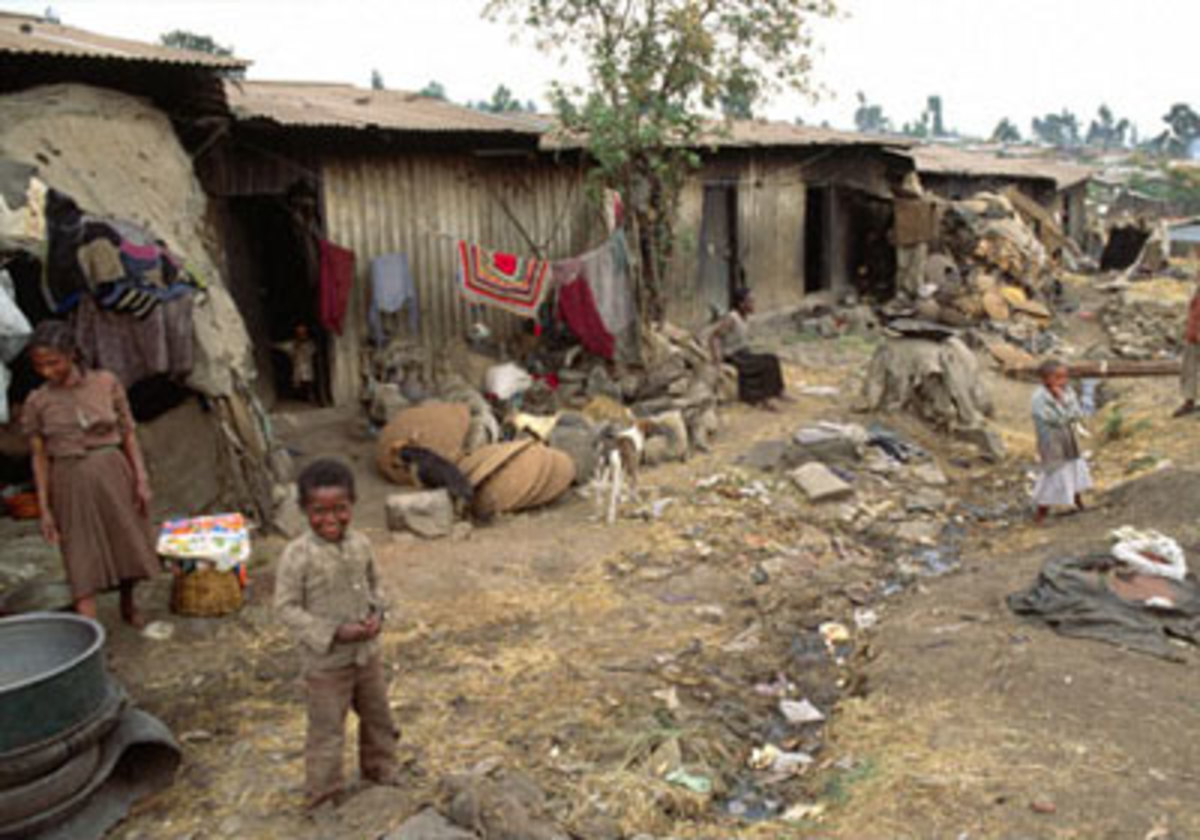
Ethiopia suffers from poverty, and poor sanitation. In the capital
city of Addis Ababa, 55% of the population lives in slums. Despite its
fast growth in recent years, GDP per capita is one of the lowest in the
world, and the economy faces a number of serious structural problems.
Ethiopia’s economy is based on agriculture, which accounts for 41% of
GDP and 85% of total employment. Agricultural productivity remains low,
the sector suffers from poor cultivation practices and frequent drought.
#16. Mali
GDP Per Capita: $1,128 (As of 2011)
With 50% of the population living below the international poverty
line of US$1.25 a day, Mali is one of the poorest countries in the
world. Some of its natural resources are gold, uranium, livestock, and
salt. Mali remains dependent on foreign aid. Economic activity is
largely confined to the riverine area irrigated by the Niger River and
about 65% of its land area is desert or semidesert. Mali experienced
economic growth of about 5% per year between 1996-2010. The government
in 2011 completed an IMF extended credit facility program that has
helped the economy grow, diversify, and attract foreign investment.
#17. Guinea-Bissau
GDP Per Capita: $1,144 (As of 2011)
Guinea-Bissau’s legal economy depends mainly on farming and fishing,
but trafficking in narcotics is probably the most lucrative trade. With
60% of the population living below the poverty line, drug traffickers
based in Latin America use Guinea-Bissau, along with several neighboring
West African nations, as a transshipment point to Europe for cocaine.
The government and the military did almost nothing to stop this
business.
#18. Comoros
GDP Per Capita: $ 1,232 (As of 2011)
Made up of three islands with rapidly increasing population, and few
natural resources. As of 2008 about 50% of the population lives below
the international poverty line of US$1.25 a day, due to numerous coups
d’etat since independence in 1975.
#19. Haiti
GDP Per Capita: $1,235 (As of 2011)
Haiti is a free market economy that enjoys the advantages of low
labor costs and tariff-free access to the US for many of its exports.
Poverty, corruption, and poor access to education for much of the
population are among Haiti’s most serious disadvantages. Haiti’s economy
suffered a severe setback in January 2010 when a 7.0 magnitude
earthquake destroyed much of its capital city, Port-au-Prince, and
neighbouring areas. Already the poorest country in the Western
Hemisphere with 80% of the population living under the poverty line and
54% in abject poverty, the earthquake inflicted $7.8 billion in
damages. Seven out of ten Haitians live on less than US$2 a day,
according to the International Red Cross.
#20. Uganda
GDP Per Capita: $1,317 (As of 2011)
Uganda is one of the poorest nations in the world, with 37.7 percent
of the population living on less than $1.25 a day. Uganda has
substantial natural resources, including fertile soils, regular
rainfall, small deposits of copper, gold, and other minerals, and
recently discovered oil. Despite making enormous progress in reducing
the countrywide poverty incidence from 56 percent of the population in
1992 to 31 per cent in 2005, poverty remains deep-rooted in the
country’s rural areas, which are home to more than 85 per cent of
Ugandans.
[Source:
Wikipedia/International Monetary Fund]